

Marketing teams were among the earliest adopters of generative AI.
From campaign ideation and ad copy to SEO content and performance analysis, AI now supports nearly every stage of the marketing lifecycle.
However, as usage matures, marketing leaders are moving beyond single-use writing tools. They are evaluating AI platforms that support collaboration, brand consistency, analytics, and cross-functional alignment.
Here are five of the best AI platforms for modern marketing teams.
1. WorkLLM
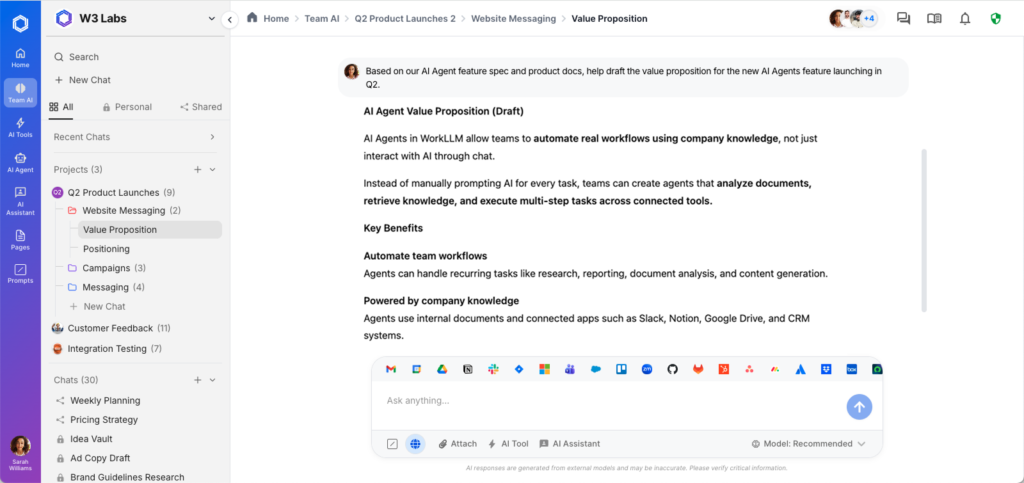
WorkLLM is built as a shared AI workspace for teams rather than a single-purpose marketing writing tool.
Marketing teams use WorkLLM to collaborate on campaign planning, positioning documents, messaging frameworks, content calendars, and cross-functional initiatives. Its layered memory architecture allows context to persist across campaigns and projects.
Unlike isolated AI writing platforms, WorkLLM supports structured collaboration between marketing, product, sales, and leadership teams.
Strengths
- Multi-LLM access in one shared environment
- Campaign-level memory and structured collaboration
- Cross-functional coordination
- Workflow integration beyond content generation
Best for
Marketing teams that operate across departments and require continuity across initiatives.
2. Jasper
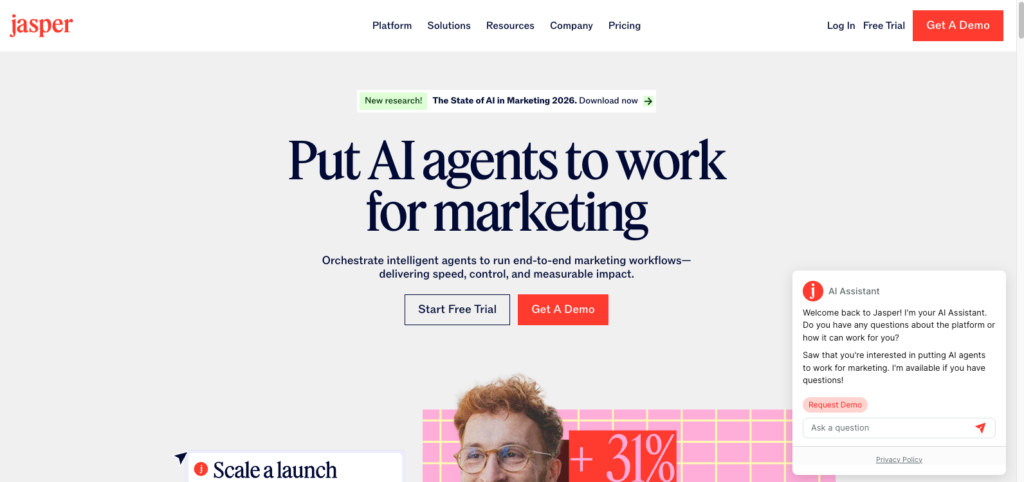
Jasper is one of the most established AI platforms focused specifically on marketing use cases.
It offers brand voice controls, campaign templates, and content workflows tailored for marketing teams. Jasper is particularly strong in scaling content production while maintaining tone consistency.
Strengths
- Brand voice customization
- Marketing-specific templates
- Content production at scale
- Structured campaign workflows
Best for
Teams focused on high-volume content generation with strong brand governance.
3. Copy.ai
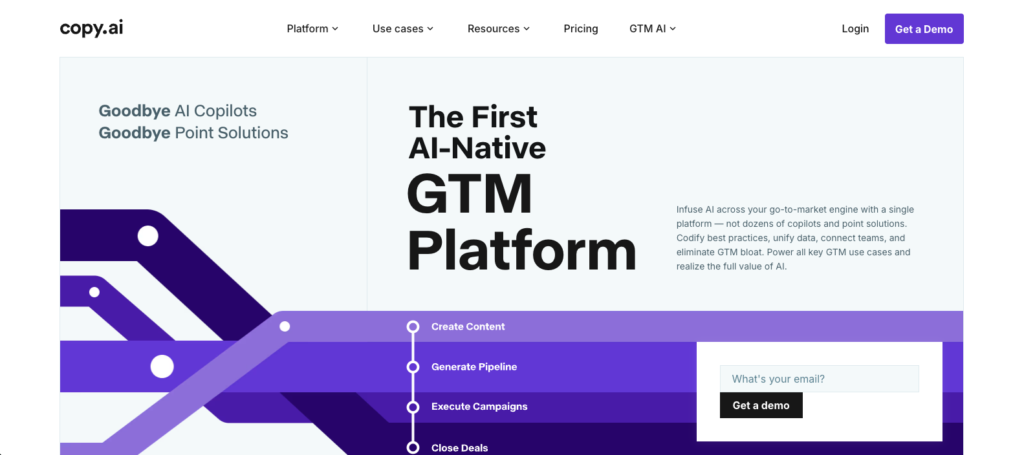
Copy.ai positions itself as a GTM AI platform, expanding beyond copywriting into go-to-market workflows.
It supports email campaigns, sales enablement messaging, and marketing automation workflows. Copy.ai emphasizes speed and ease of use for demand generation teams.
Strengths
- Go-to-market workflow support
- Sales and marketing messaging alignment
- Easy onboarding for teams
Best for
Demand generation and revenue marketing teams that need fast iteration across messaging assets.
4. Writesonic
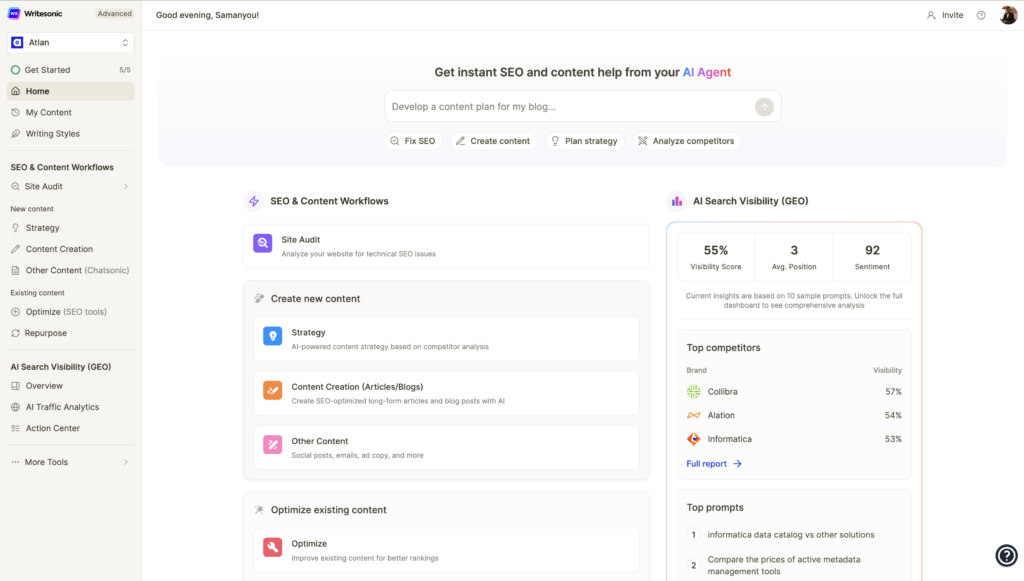
Writesonic focuses heavily on SEO-driven content and blog generation.
It integrates keyword research, AI writing, and optimization workflows into one platform. For marketing teams prioritizing organic traffic growth, Writesonic provides structured SEO assistance.
Strengths
- SEO-focused content workflows
- Keyword optimization tools
- Long-form blog generation
Best for
Content marketing teams targeting search growth and blog production.
5. Juma AI
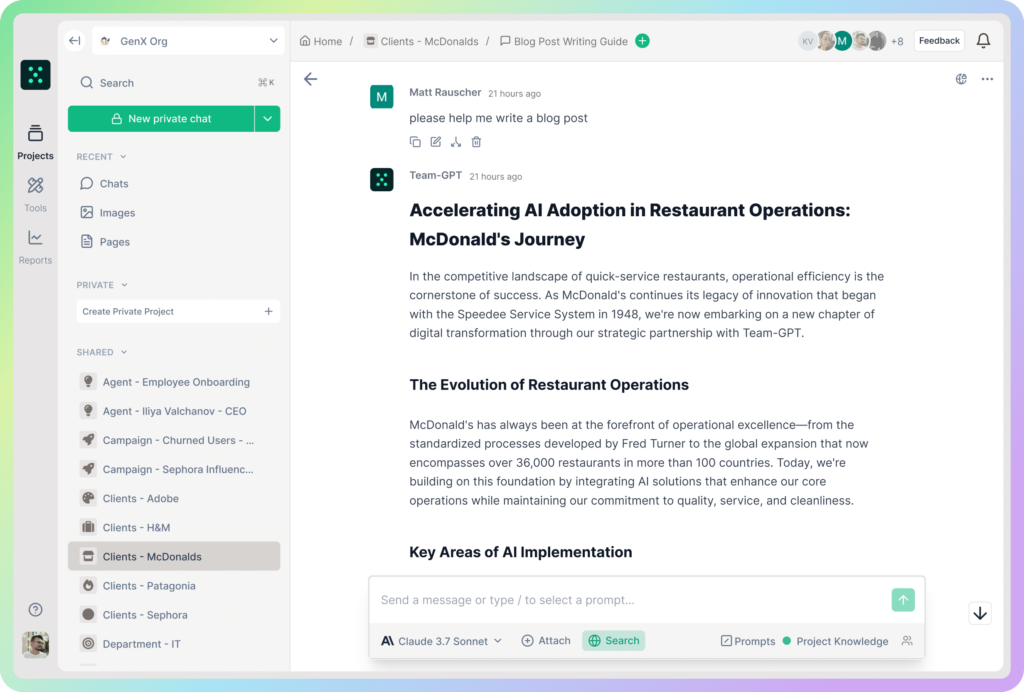
Juma.ai is a dedicated AI workspace built specifically for marketing teams and agencies. It focuses on collaborative content creation, brand voice management, shared projects, and reusable marketing playbooks within a centralized environment.
Marketing teams use Juma to co-create campaigns, manage content workflows, and maintain consistency across clients or initiatives using a structured, team-based AI workspace.
Strengths
- Team-first AI workspace for marketing
- Brand voice and shared project structure
- Marketing playbooks and workflow templates
Best for
Marketing teams and agencies that want collaborative AI content and campaign workflows in one shared workspace.ls.
Summary Comparison Table
| Platform | Core Positioning | Marketing Capability | Team Collaboration | Multi-Model Access | AI Execution Layer |
|---|---|---|---|---|---|
| WorkLLM | AI workspace & orchestration | Advanced (content + workflows + cross-functional coordination) | High | Yes | Full (Tools, Assistants, Agents) |
| Jasper | Marketing content platform | Strong (brand voice + campaign workflows) | Moderate | Varies by plan | Limited |
| Copy.ai | GTM content & workflows | Strong (GTM messaging + workflows) | Moderate | Varies by plan | Limited |
| Writesonic | SEO content platform | Strong (SEO content & optimization) | Low to Moderate | Varies by plan | Limited |
| Juma AI | Marketing AI workplace | Strong (brand voice + playbooks + shared projects) | High | Yes | Workflow-oriented |
What Marketing Leaders Should Evaluate
Selecting the right AI platform depends on maturity and structure.
Marketing leaders should consider:
Brand Governance
Can the platform enforce tone and positioning consistently?
Cross-Functional Alignment
Does AI operate only within marketing, or can it integrate with product and sales workflows?
Campaign Memory
Does the system retain context across launches and initiatives?
SEO and Performance Integration
Is optimization embedded into the workflow?
Governance and Visibility
Can leadership track AI usage and outputs across the team?
Many teams begin with content-generation platforms. As scale increases, alignment and workflow coordination become more important than raw output speed.
The Shift from Content Tools to Marketing Infrastructure
AI for marketing has evolved quickly.
The first wave focused on faster copywriting. The second wave integrates AI into campaign planning, collaboration, and execution.
Platforms like Jasper, Copy.ai, and Writesonic specialize in content acceleration. Collaborative AI workspaces focus on structuring shared knowledge and coordination.
At WorkLLM, the focus is on shared memory, multi-model flexibility, and embedding AI into how teams plan and execute campaigns together.
For marketing teams operating cross-functionally, AI infrastructure matters as much as content speed.
Final Thoughts
The right AI platform for marketing teams depends on how AI is used inside the organization.
If the primary need is faster content production, specialized platforms such as Jasper, Copy.ai, or Writesonic can accelerate writing workflows. As marketing operations grow more complex, however, teams often require stronger collaboration, campaign memory, and cross-functional alignment.
This is where AI workspaces such as WorkLLM become increasingly relevant. By combining shared memory, multi-model access, assistants, agents, and workflow coordination in one environment, WorkLLM enables marketing teams to move beyond isolated content generation and toward structured campaign execution.
As AI adoption matures, the competitive advantage will not come from producing more content. It will come from how effectively marketing teams coordinate intelligence across campaigns, tools, and departments.