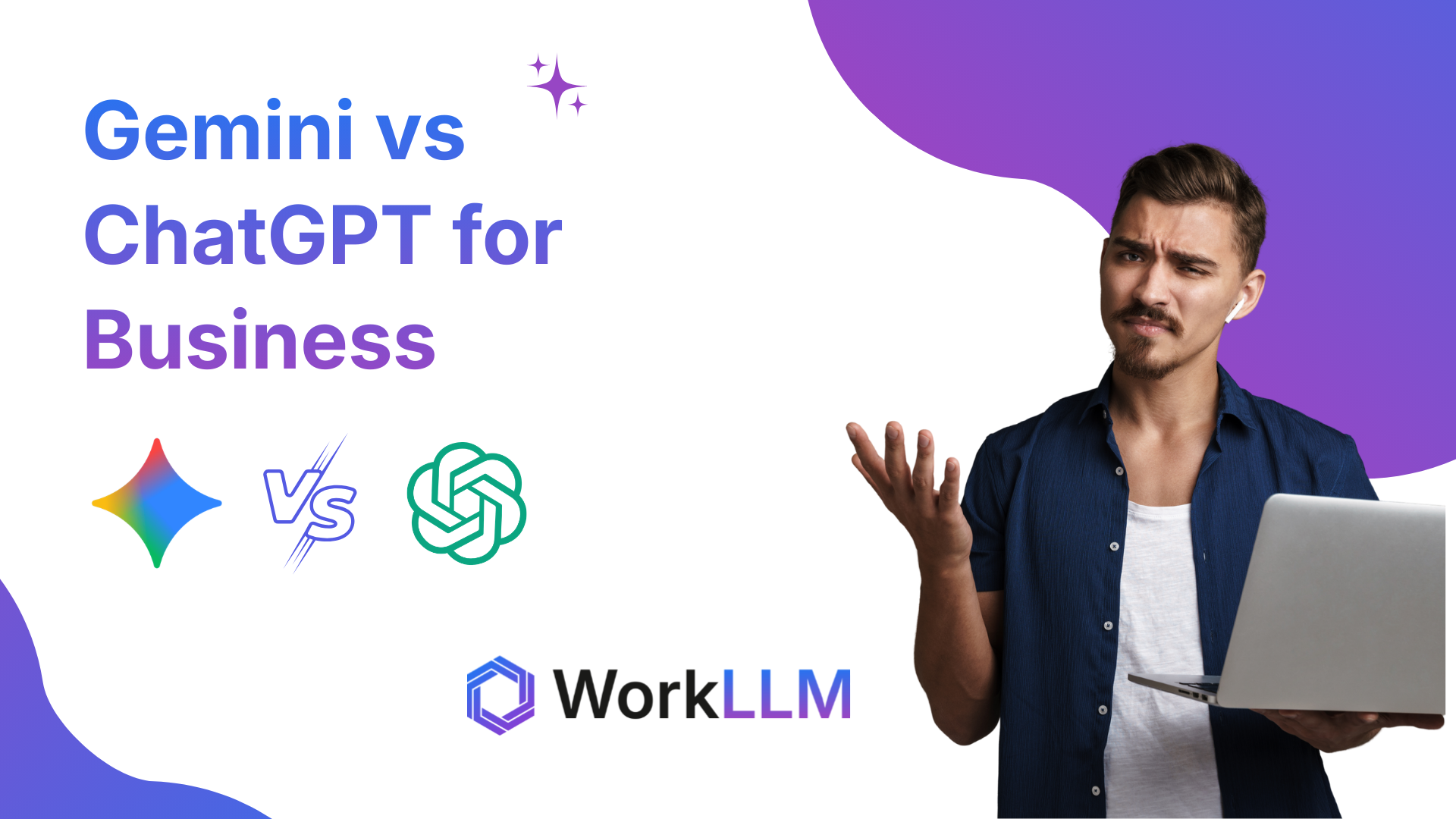
As generative AI adoption accelerates, most enterprises evaluating AI platforms narrow their shortlist to two dominant players: Gemini and ChatGPT.
Both are powerful. Both are enterprise-ready. Both continue to evolve rapidly.
But choosing between them requires looking beyond marketing claims and benchmark headlines. For business leaders, the decision is about ecosystem fit, governance, flexibility, and long-term strategy.
Here is a practical comparison.
Model Performance and Capability
ChatGPT, developed by OpenAI, is widely recognized for strong reasoning, structured outputs, coding support, and versatility across business use cases. It has become a standard starting point for organizations experimenting with generative AI.
Gemini, developed by Google, emphasizes multimodal capabilities and deep integration within the Google ecosystem. It benefits from Google’s infrastructure, search capabilities, and Workspace integration.
For common business tasks such as drafting, summarization, analysis, and research, both platforms perform at a high level. Differences tend to be incremental rather than decisive for most knowledge work scenarios.
In practical terms, either model can handle the majority of enterprise use cases effectively.
Ecosystem and Integration Strategy
Where the platforms begin to diverge is in ecosystem alignment.
ChatGPT offers:
- Flexible API access for custom applications
- Integration across multiple third-party tools
- Custom GPT configurations
- A growing ecosystem of extensions
Gemini offers:
- Native embedding inside Google Docs, Sheets, Gmail, and Meet
- Integration within Google Admin controls
- Alignment with Google Cloud infrastructure
Organizations deeply invested in Google Workspace may find Gemini operationally seamless. Companies operating in mixed environments or building custom AI-driven workflows may prefer the flexibility of ChatGPT’s broader integration model.
Enterprise Governance and Security
Security and compliance are central concerns for business deployment.
ChatGPT Enterprise provides:
- Data isolation from model training
- Administrative controls
- Usage visibility
- Compliance certifications
Gemini inherits enterprise-grade controls from Google Cloud and Workspace, including centralized administration and policy management.
For regulated industries, both platforms require due diligence and internal security evaluation. At a high level, enterprise governance maturity exists on both sides.
Cost and Licensing Considerations
Pricing structures vary depending on subscription tiers, bundling, and volume agreements.
ChatGPT is typically licensed per user for business and enterprise plans, with additional API-based consumption models available.
Gemini pricing is often integrated into Google Workspace tiers or offered as enterprise add-ons.
The true cost comparison depends on existing vendor contracts and infrastructure alignment.
The Broader Enterprise Question
For many organizations, the model comparison is only part of the decision.
Both Gemini and ChatGPT significantly improve individual productivity. Employees write faster, analyze more efficiently, and prepare better. These gains are measurable and meaningful.
However, enterprise performance depends on more than individual speed.
Leaders increasingly ask:
- Does AI improve shared understanding?
- Does it reduce repeated explanations?
- Does it preserve project memory over time?
- Does it integrate into execution systems?
- Does it support cross-functional alignment?
In many deployments, AI usage grows quickly while team-level ROI remains harder to quantify. The limitation is rarely the foundation model itself. It is how that model is embedded into team workflows.
Moving Beyond the Model
As AI strategies mature, enterprises are beginning to think beyond selecting a single model.
Foundation models such as Gemini and ChatGPT provide intelligence engines. What organizations often lack is a unifying layer that:
- Enables access to multiple models in one environment
- Preserves shared context across projects and teams
- Embeds memory into workflows
- Connects AI outputs directly to operational systems
- Provides governance across the entire AI stack
This is where enterprises begin to look beyond model selection and toward orchestration platforms designed specifically for team coordination.
For example, many organizations use both Gemini and ChatGPT across departments. Marketing may prefer Gemini for Workspace integration, while product or engineering teams rely on ChatGPT’s broader API ecosystem. Without a centralized layer, AI usage fragments across tools.
At WorkLLM, the focus is not on replacing Gemini or ChatGPT. It is on operating above them.
WorkLLM acts as a centralized AI workspace that integrates multiple models, structures shared memory, and embeds intelligence directly into collaborative workflows. In this architecture, foundation models become components of a broader system designed for team-level coordination and continuity.
Choosing the Right Path
For organizations deeply aligned with Google Workspace, Gemini may offer seamless ecosystem integration. For enterprises prioritizing API flexibility and cross-platform adaptability, ChatGPT may provide broader optionality.
However, in mature enterprise environments, the more strategic question is not which model performs slightly better. It is how AI operates across teams.
Many organizations end up using both Gemini and ChatGPT for different workflows. Without coordination, usage can fragment across departments, reducing visibility and complicating governance.
This is where orchestration platforms like WorkLLM become strategically important. Rather than replacing either model, WorkLLM provides a unified workspace that integrates multiple models, preserves shared memory, and embeds intelligence into structured workflows.
The long-term advantage will not come from model selection alone. It will come from how effectively intelligence is structured across the organization.
Author Details

Ankit Sharma is a Full Stack Software Engineer specializing in scalable backend systems, AI-powered applications, and multi-tenant architectures. He has experience building high-performance platforms using Node.js, Next.js, PostgreSQL, MongoDB, AWS, and modern JavaScript technologies.