As AI adoption grows inside organizations, relying on a single model is becoming increasingly limiting. Different teams prefer different models. Performance varies by task. Pricing fluctuates. Governance requirements differ by region.
Multi-LLM platforms allow businesses to access multiple foundation models from a single environment, reducing vendor lock-in and increasing flexibility.
Here are five leading multi-LLM platforms designed for business use.
1. WorkLLM
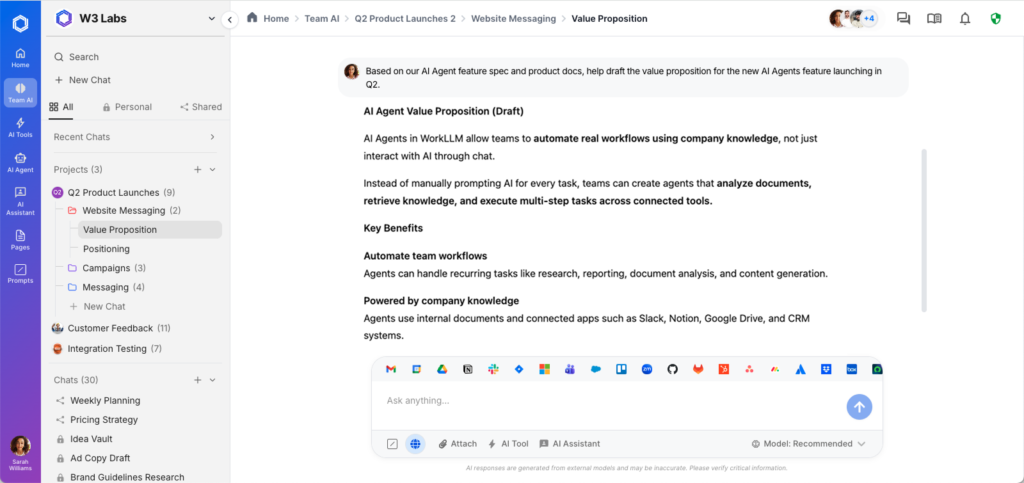
WorkLLM is positioned as a multi-LLM AI workspace built for teams. It enables businesses to access multiple foundation models within a shared environment while maintaining structured memory, collaboration, and execution layers such as AI Tools, AI Assistants, and AI Agents.
Rather than limiting AI to chat, WorkLLM integrates model flexibility with workflow execution and team coordination.
Strengths
- Multi-LLM access in one workspace
- Layered memory across projects and teams
- AI Tools for repeatable workflows
- AI Assistants and AI Agents for execution
Best for
Businesses that want multi-model flexibility combined with structured team collaboration and execution.
2. Langdock
Langdock positions itself as an enterprise AI platform that provides centralized access to multiple language models within a secure and governed environment. It emphasizes controlled rollout of AI across organizations and streamlined access to different models from one interface.
Strengths
- Centralized access to multiple models
- Enterprise security and governance focus
- Organization-wide AI deployment
Best for
Businesses that want multi-model access with centralized governance and secure rollout.
3. Juma AI
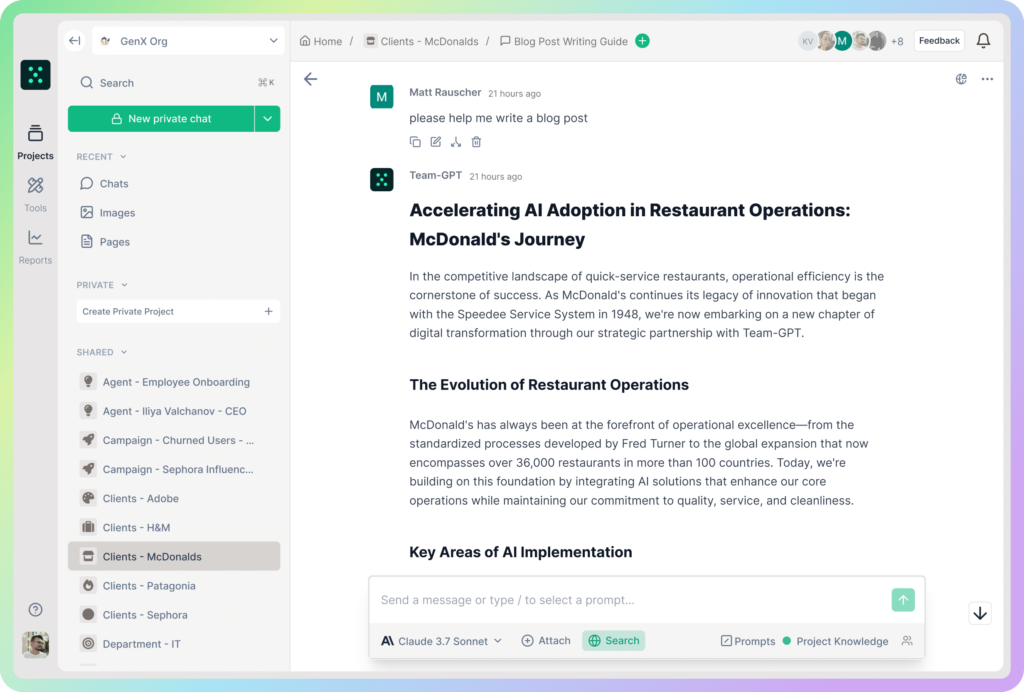
Juma (formerly Team-GPT) is a marketing-focused AI workplace that explicitly supports multiple leading models within one collaborative environment. It allows teams to switch between models while working inside shared projects and brand-controlled workflows.
Strengths
- Explicit multi-model support
- Collaborative workspace for marketing teams
- Brand voice and structured playbooks
Best for
Marketing teams and agencies that want multi-model flexibility inside a shared AI workspace.
4. Abacus.AI
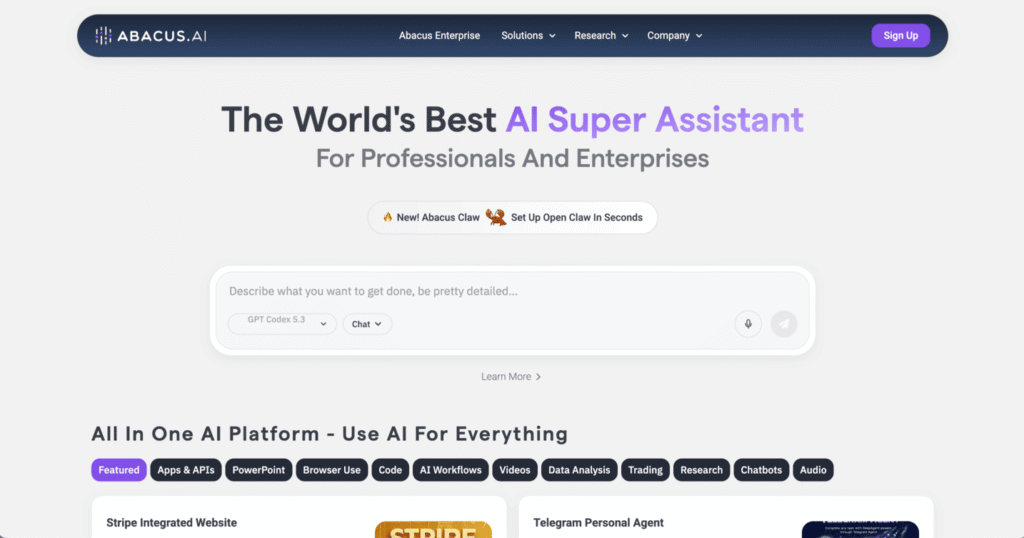
Abacus.AI offers a generative AI platform that supports routing across multiple foundation models. Its RouteLLM capability allows businesses to dynamically select or route requests across different models based on task requirements.
Strengths
- Multi-model routing capability
- Enterprise GenAI workflows
- Applied AI system building
Best for
Businesses that want model routing and applied AI systems within one platform.
5. Team AI
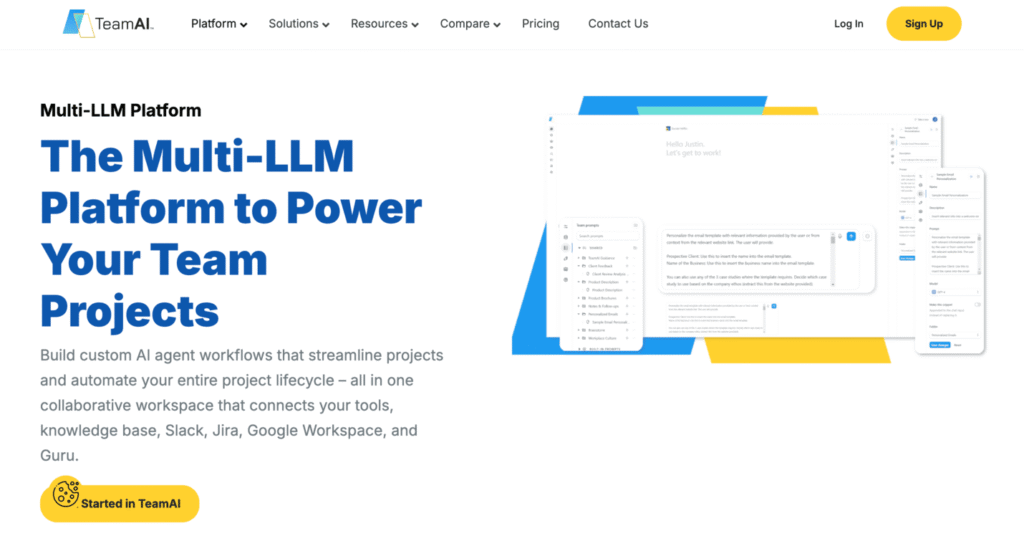
Team AI positions itself as a collaborative AI workspace for teams, providing access to multiple models in one shared environment. It emphasizes structured workspaces, shared prompts, and team-based AI usage rather than individual chat accounts.
Strengths
- Multi-model access in a shared workspace
- Team-based prompt libraries
- Collaborative AI usage structure
Best for
Businesses seeking a lightweight multi-LLM collaboration platform for teams.
Summary Comparison Table
| Platform | Core Positioning | Multi-LLM Support | Team Collaboration | AI Execution Layer | Best For |
|---|---|---|---|---|---|
| WorkLLM | AI workspace & orchestration | Yes | High | Full (Tools, Assistants, Agents) | Structured team workflows |
| Langdock | Enterprise AI platform | Yes | Moderate | Limited | Governed enterprise rollout |
| Juma AI | Marketing AI workplace | Yes | High | Workflow-oriented | Marketing teams |
| Abacus.AI | GenAI platform with routing | Yes | Low–Moderate | Workflows + routing | Applied AI systems |
| Team AI | Collaborative AI workspace | Yes | High | Limited | Team-based multi-model collaboration |
Choosing the Right Multi-LLM Platform
Multi-LLM access is quickly becoming table stakes for modern AI platforms. The real differentiation lies in how that flexibility is structured across the business.
Some platforms focus primarily on centralized governance. Others emphasize routing and infrastructure control. A smaller group combines multi-model access with collaboration, memory, and execution.
If your objective is simply switching between models, many platforms can support that. If your objective is coordinating how teams use multiple models across projects and workflows, the architecture matters.
WorkLLM is designed for the latter. It brings multi-LLM flexibility into a shared workspace with structured memory and execution layers, ensuring that model choice translates into coordinated action.
As enterprise AI adoption matures, the question is no longer whether you support multiple models. It is how effectively your organization operationalizes them.
Author Details

Senior engineering leader with experience building large-scale systems, infrastructure, and production-grade software. Focused on creating reliable, scalable technology for real-world business use.