
AI Tool: Marketing Budget Planner

Create a data-driven marketing budget allocation plan that optimizes performance, aligns with your objectives, and respects financial constraints.

Pricing

Included in paid plans.

Provided By

WorkLLM

Category

Content, Agencies, Advertisement, Content

Tool Owner

Chief Marketing Officer / Head of Growth / Finance Lead

Owner Role

Owns historical performance data, CPA/CAC benchmarks, revenue targets, and approved channels to ensure budget plans are realistic, aligned, and strategic.

AI Tool Logic

Managed by WorkLLM

LLM Compatibility

Model Agnostic. Works with any Text based Models.

Description

The Marketing Budget Planner serves as a senior growth finance strategist and performance marketing analyst. It generates a structured, performance-driven budget allocation plan by leveraging historical data, financial targets, and user-defined goals. The tool’s key capabilities include:

  • Allocating budgets based on historical channel performance and strategic objectives.
  • Performing scenario modeling and sensitivity analysis to evaluate different market conditions.
  • Creating a deployment timeline and monitoring framework to track execution.
  • Ensuring compliance with business financial targets and approved marketing channels.

Context & Knowledge Base

To maximize the tool’s effectiveness, it’s critical to maintain and upload the following documents:

Strongly Recommended

  • Historical Channel Performance Data – Past performance metrics for each marketing channel.
  • CPA/CAC Benchmarks – Cost benchmarks for acquiring customers.
  • ROAS Data – Return on ad spend by channel.
  • Conversion Rate Benchmarks – Typical conversion rates to measure effectiveness.
  • LTV Assumptions – Lifetime value assumptions for different customer segments.
  • Business Financial Targets – Overall financial goals and metrics.
  • Revenue Forecasting Model – Projections of expected revenue.
  • Approved Channel List – Channels authorized for marketing efforts.
  • Attribution Model Notes – How credit is assigned for conversions across channels.

Optional but Powerful

  • Seasonal Performance Patterns – Trends and variations in performance by season.
  • Sales Funnel Conversion Rates – Conversion efficiency at different funnel stages.
  • Channel Capacity Constraints – Limits on channel scalability.
  • Growth Targets by Segment – Specific growth objectives for different market segments.
  • Product Margin Data – Profit margins for different product lines.
  • Market Conditions Assumptions – External factors influencing market dynamics.
  • Budget Allocation Framework – Company-defined rules for distributing budgets.

Input

Provide the necessary details to tailor the budget plan to your objectives and constraints.

Required Inputs

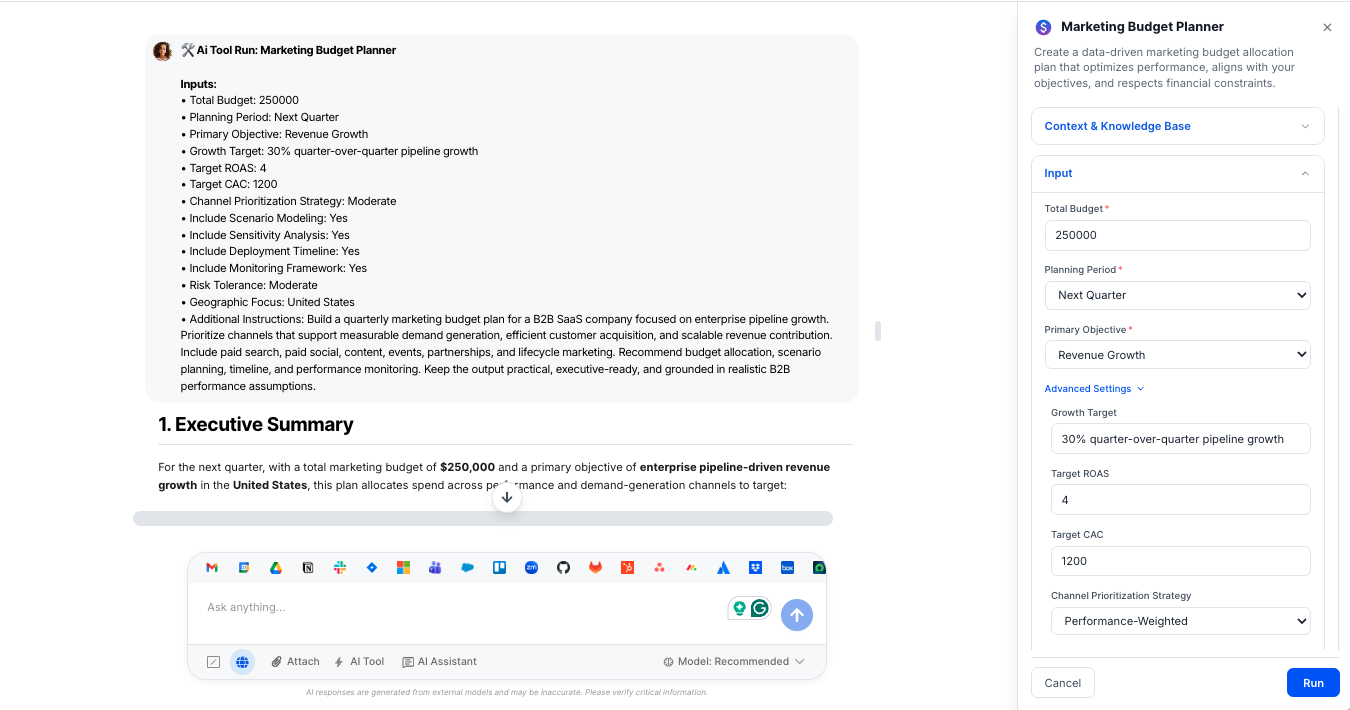
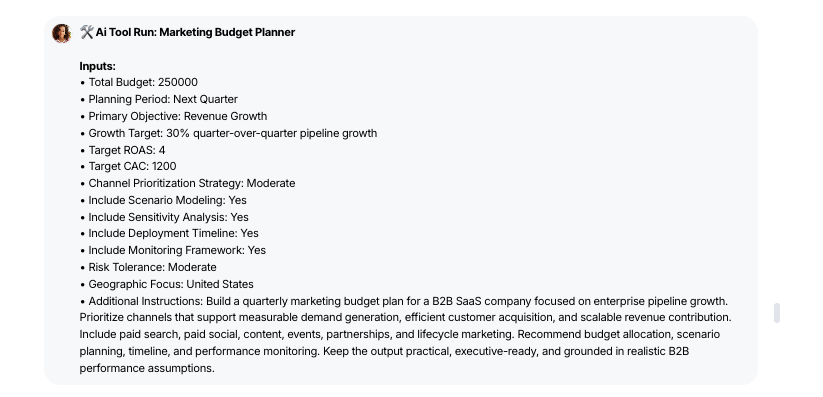
  • Total Budget – The overall budget available for allocation (numeric, currency).
  • Planning Period – The time frame for which the budget is planned (e.g., next quarter).
  • Primary Objective – The main goal of the marketing plan (e.g., revenue growth).

Advanced Inputs (Optional)

  • Growth Target – Specific growth ambition (e.g., 25% QoQ growth).
  • Target ROAS – Desired return on ad spend value.
  • Target CAC – Desired cost per customer acquisition.
  • Channel Prioritization Strategy – Approach for prioritizing channels (e.g., performance-weighted).
  • Include Scenario Modeling – Whether to simulate different market scenarios.
  • Include Sensitivity Analysis – Whether to analyze budget sensitivity to changes.
  • Include Deployment Timeline – Whether to outline a step-by-step deployment plan.
  • Include Monitoring Framework – Whether to define KPIs and monitoring thresholds.
  • Risk Tolerance – Willingness to take risks in budget allocation.
  • Geographic Focus – Specific areas or regions to prioritize.

Output

Receive a comprehensive, data-driven budget plan and execution insights.

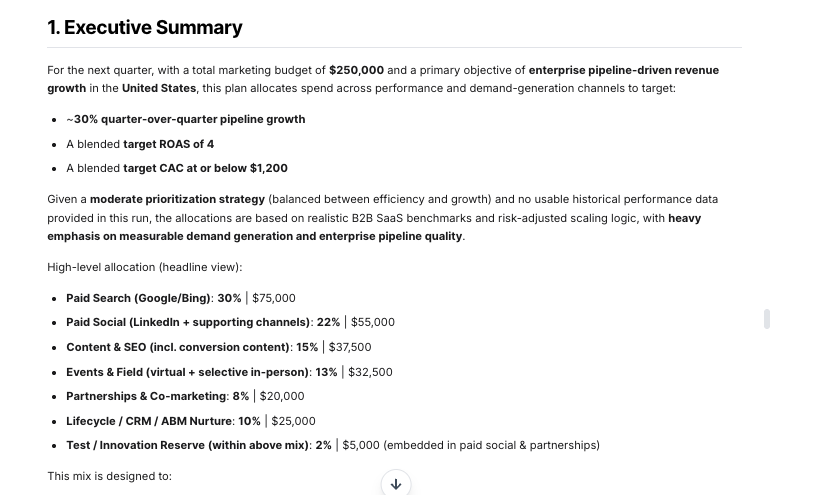
  • Executive Summary – A high-level overview of the budget plan.
  • Extracted Data Overview – Summary of historical data used.
  • Allocation Model Explanation – How the budget was distributed across channels.
  • Channel-by-Channel Allocation Table – Detailed budget allocation for each channel.
  • Scenario Modeling – Alternative budget scenarios (if enabled).
  • Sensitivity Analysis – Impact of changes in market conditions (if enabled).
  • Deployment Timeline – Timeline for budget implementation (if enabled).
  • Monitoring Framework – KPIs and thresholds for ongoing monitoring (if enabled).
  • Assumptions Applied – Key assumptions made due to data gaps.

Execution Insights

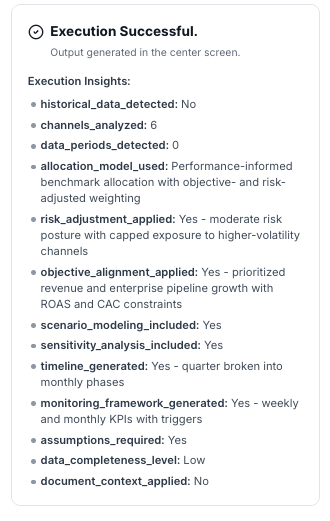
Understand how the budget plan was developed and tailored to your needs.

  • Historical Data Detected – Confirms if historical data was used.
  • Channels Analyzed – Number of channels evaluated.
  • Data Periods Detected – Number of time periods analyzed.
  • Allocation Model Used – Methodology for budget distribution.
  • Risk Adjustment Applied – Adjustment based on risk tolerance.
  • Objective Alignment Applied – Alignment with primary marketing objective.
  • Scenario Modeling Included – Indicates if scenario modeling was performed.
  • Sensitivity Analysis Included – Indicates if sensitivity analysis was conducted.
  • Timeline Generated – Confirms if a deployment timeline was created.
  • Monitoring Framework Generated – Confirms if a monitoring framework was included.
  • Assumptions Required – Indicates if assumptions were necessary due to data gaps.
  • Data Completeness Level – Completeness of data used (high, medium, low).
  • Document Context Applied – Confirms if document context was utilized.

Who is this for?

  • Marketing Leaders & CMOs – Strategic budget planning and channel optimization
  • Growth Teams – Performance-driven allocation across acquisition channels
  • Finance & Operations – Marketing ROI planning and budget governance
  • Digital Marketing Managers – Channel-specific budget optimization and forecasting
  • Revenue Operations – Aligning marketing spend with revenue targets
  • Agency Account Managers – Client budget planning and performance optimization 

Data & Permissions

Marketing Budget Planner operates exclusively within your organization’s secure WorkLLM workspace.

  • Org-Scoped Workspace – All historical data, budget plans, and performance metrics remain isolated to your organization and are never shared across customers.
  • Document-Driven Context – Reads your historical performance data, benchmarks, and financial targets at runtime to inform budget allocation but never modifies source documents.
  • Per-Run Inputs – Budget amounts, objectives, and planning constraints are used only for that specific budget plan generation.
  • No Automatic External Connections – The tool doesn’t automatically connect to your advertising platforms, analytics tools, or financial systems unless explicitly integrated by your admins.
  • Role-Based Access Control – Access to budget planning, historical data, and generated plans is governed by your workspace permission model (e.g., marketing leadership vs. analysts vs. finance team).

Security

  • All uploaded documents and inputs remain within your organization’s secure WorkLLM workspace.
  • No data is shared externally or used to train third-party models.
  • Enterprise-grade encryption and role-based access controls apply to all content and runs.

Governance

WorkLLM provides structure, control, and consistency across every execution.

  • Tool Logic: Managed by WorkLLM
  • Default Context: Managed by Chief Marketing Officer / Head of Growth / Finance Lead
  • Visibility: Organization-wide
  • User Customization: Input-level only

This ensures standardized outputs across teams while still allowing flexibility at execution time.

Similar AI Tools

Brand Guidelines Creator

By: WorkLLM

Create comprehensive, actionable brand voice guidelines that ensure consistency across all marketing, sales, support, and AI-assisted content.

Press Release Writer

By: WorkLLM

Generate professional, publication-ready press releases that align with your brand voice, follow journalistic standards, and maintain credibility across all distribution channels.

Abandoned Cart Email Sequence Writer

By: WorkLLM

Generate high-converting, brand-aligned abandoned cart email sequences that recover revenue while maintaining customer trust and compliance.

Client Proposal Generator

By: WorkLLM

Create structured, persuasive, and commercially realistic client proposals in minutes—aligned with your real pricing, services, and legal terms, not AI guesswork.

Tone Controlled Response Tool

By: WorkLLM

Rewrite any message into the exact tone you need—on‑brand, de‑risked, and ready to send for support, internal comms, or executive use.

Offer Letter Writer

By: WorkLLM

Generate structured, accurate, and compliant offer letter drafts in minutes—grounded in your official templates and policies, not AI guesswork.

Happy Customers

Customer satisfaction is our major goal. See what our customers are saying about us.