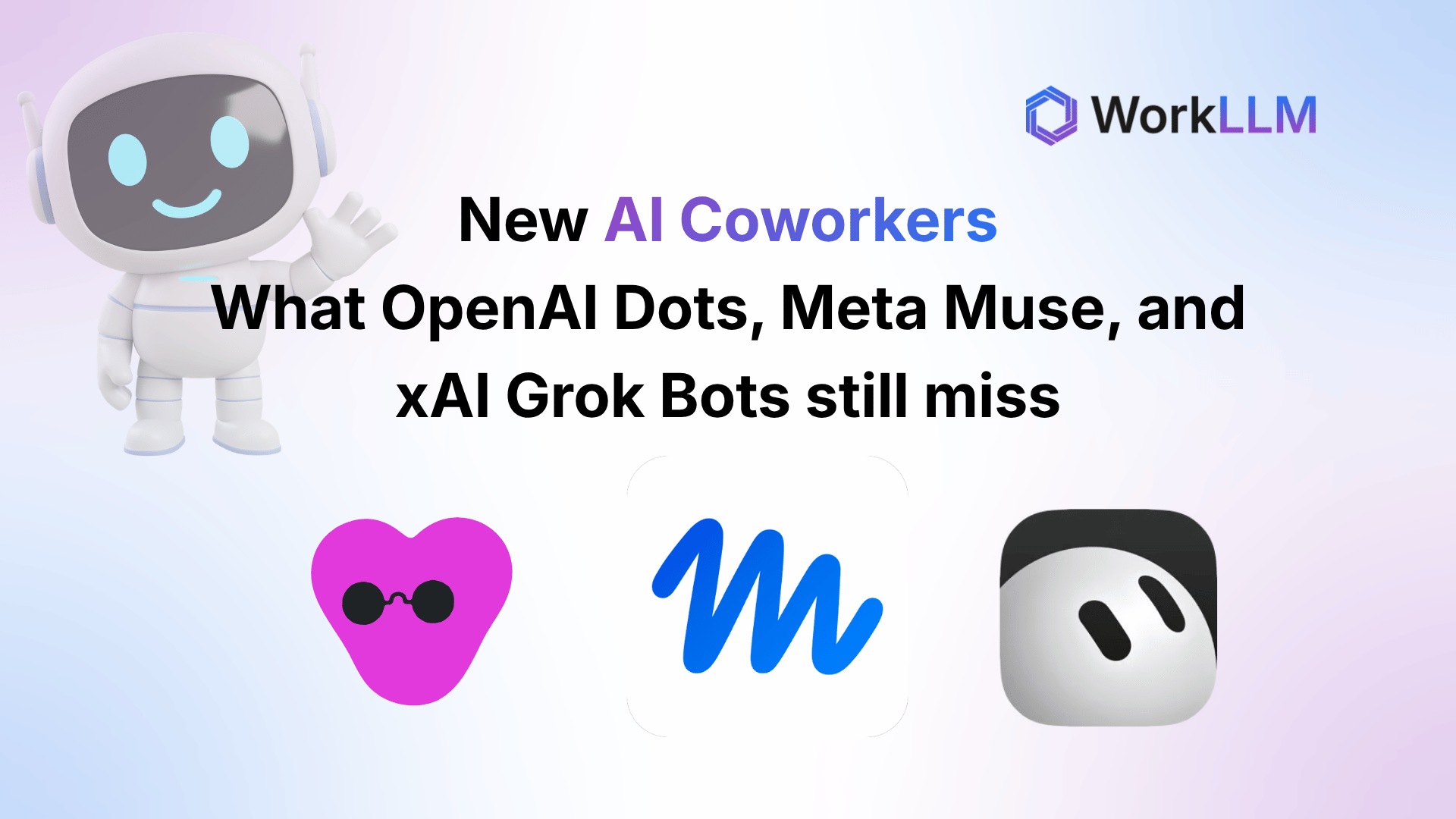
In the span of about seven weeks this fall, three of the biggest names in tech each shipped their own version of an AI coworker. xAI launched Grok Bot in August. Meta launched Muse on September 8. OpenAI launched Dots at its DevDay keynote on September 29. If you run a small or mid-sized business and you’ve been trying to figure out what any of this actually means for your own day-to-day work, you’re not alone, and you’re not late. Here’s what each product actually does, what they genuinely get right, and where the gap still sits for a business that isn’t a tech company.
Quick answer: Dots, Grok Bot, and Muse are all genuine steps toward AI that works on its own rather than waiting for a prompt. Each one is still built around a single person’s subscription and a single person’s assistant, though. None of them give a whole business a shared place where every department’s work runs on the same standard, with one view of what ran, who ran it, and what it cost.
What Grok Bot actually does
Grok Bot launched in beta on August 11 as xAI’s answer to “AI teammates you can give real work to.” Each bot gets its own cloud computer with browser, terminal, and file access, and you message it the way you’d message a colleague. A feature called Learned Routines lets you walk a bot through a task once, and it can run that same task on its own afterward, which is close to how an AI agent should work for any business, not just a tech one.
Grok Bot isn’t sold on its own. It rides on premium subscriptions, SuperGrok Plus, SuperGrok Heavy, or Cursor’s paid tiers, running from roughly $100 to $300 a month per person. It’s also built for one person’s account. Multiple bots on the same account share one cloud computer, including one set of browser cookies and credentials, which is a reasonable setup for an individual juggling a few assistants and a much harder one to hand to five different employees who each need their own access and their own history.
What Meta’s Muse actually does
Muse launched on September 8 and quickly became the top free app in the US. It’s a personal AI agent that runs on its own cloud virtual machine and reaches you through Meta’s own apps, mainly Messenger. Meta describes it handling things like drafting and sending email, booking travel, and turning a recipe into a grocery list.
Muse is free and consumer-first by design, which is exactly why it spread so fast. It’s also built around one person’s inbox and one person’s day, not a company’s shared way of handling, say, every new lead or every client report. If three people on your team each start using Muse for the same kind of task, each one is teaching it from scratch, with nothing carrying over from one person’s setup to the next.
What OpenAI’s Dots actually does
Dots launched at OpenAI’s DevDay on September 29. OpenAI describes it as an always-on agent, powered by GPT-6 Astra, that works from its own cloud computer and keeps going on a task even after you close the chat. It’s available now to ChatGPT Pro and Business Premium users, with one dot included per plan.
What’s worth noting here, and credit where it’s due, is that OpenAI also introduced “specialist dots” built around a role rather than a person, piloted internally for things like invoice processing and customer support, alongside a shared workspace called Space and documents called Pages that people and dots edit together. That’s a real move toward something closer to a company-wide system. It’s also explicitly early. OpenAI describes specialist dots as pilot stage, and the governance and security layer is being built with Microsoft’s Agent 365, which is squarely aimed at enterprise IT departments, not a 20-person agency setting things up on its own.
The common thread: built for one person, not one business
Line up all three and the shape is the same. Each product gives an individual a capable assistant that remembers how they like a task done. None of them were built around the idea that an accounting firm, a marketing agency, or a home services business has its own knowledge, its own standards, and work that needs to look the same no matter which employee is handling it that week.
Think about something as ordinary as a weekly client report. If three account managers each set up their own version of Grok Bot, Muse, or Dots to help with it, you get three slightly different reports, three separate places where that setup lives, and no shared record of what ran or how often. That’s not a knock on any of these products. It’s simply not the problem they were built to solve.
What this costs a growing business
The real cost shows up later, not on day one. A personal AI coworker genuinely helps the person using it. What it doesn’t do is survive that person leaving, going on leave, or just being out sick. The next person covering the account starts over, because nothing about how the task was set up lives anywhere they can reach.
It also leaves leadership without a clear answer to a simple question: how much of our actual client work is running through AI right now, and what’s it costing us. Three or four employees each on their own subscription, each with their own setup, don’t add up to a picture anyone can actually see.
Common worries about moving past a personal AI coworker
Business owners weighing this usually land on the same few concerns, and they’re fair ones.
- Cost: Grok Bot’s premium tiers run $100 to $300 a month per person before you’ve set anything up for the business. A shared setup built around the work itself, rather than per-person subscriptions, tends to cost less to actually run across a team.
- Technical skill: None of this requires anyone to code or learn a new interface. You tell the system what you need the way you’d explain it to a new hire, and it asks what it needs to know the first time.
- Data and access: It’s reasonable to want to know who can see what. A proper setup logs every run, so you can see exactly what happened and who asked for it, rather than taking it on faith.
Where WorkLLM fits
This is exactly the gap WorkLLM is built to close. It’s an end-to-end workflow automation platform built for the work a small or mid-sized business already does, not a personal assistant tied to one person’s subscription.
Here’s what that looks like in practice. Say your team wants an AI agent to handle new client onboarding. You ask it to do the task, the way you’d brief a new hire. The first time, it asks a few guiding questions, what information to collect, what the welcome email should say, which internal steps come next. It remembers your answers. After that, it runs the same way every time, for anyone on the team who needs it, not just the person who set it up.
That workflow gets saved, so the next account manager, the one covering for someone out sick, or the new hire in their first week, gets the exact same standard without having to rebuild it. And because everything runs through one shared place, you get full logs: what ran, who ran it, how often, and what it’s costing in spend and usage. That’s the piece a personal AI coworker, however capable, was never built to give you.
Frequently asked questions
Is Grok Bot, Muse, or Dots available for a small business right now?
Grok Bot and Dots both currently require a paid individual subscription (SuperGrok, Cursor, or ChatGPT Pro/Business Premium), and both are scoped to one person’s account rather than a business-wide setup. Muse is free but also built around one person’s use, accessed mainly through Messenger.
Can I use more than one of these together?
There’s nothing stopping someone from running Grok Bot, Muse, and Dots side by side, but nothing connects them. Each one holds its own separate setup and its own separate memory of how you like things done.
Do any of these offer a shared view across a whole company?
OpenAI’s Dots comes closest, with Space, a shared workspace for people and dots, and specialist dots piloted for specific roles. OpenAI describes that layer as early and pairs its governance with Microsoft Agent 365, which is built for enterprise IT, not a small non-technical business setting things up directly.
Is switching to a shared AI workspace a big technical project?
No. Setting up an AI agent for a specific task is a short conversation, not a technical build. You describe the task once, the way you’d train a new employee, and it remembers from there.
A next step worth taking
Grok Bot, Muse, and Dots are all real signs that AI is moving from something you chat with to something that gets work done on its own. For a small or mid-sized business, the part worth paying attention to isn’t which one has the flashiest demo. It’s whether the work itself, not just one person’s habits, ends up running on AI in a way the whole business can rely on. If you want to see what that looks like for your own team, take a look at the AI agents on workllm.io, or reach out to us directly at hello@workllm.io.
Author Details

Product-focused founder with deep experience in AI, enterprise software, and data platforms. Passionate about turning complex workplace problems into simple, scalable products.