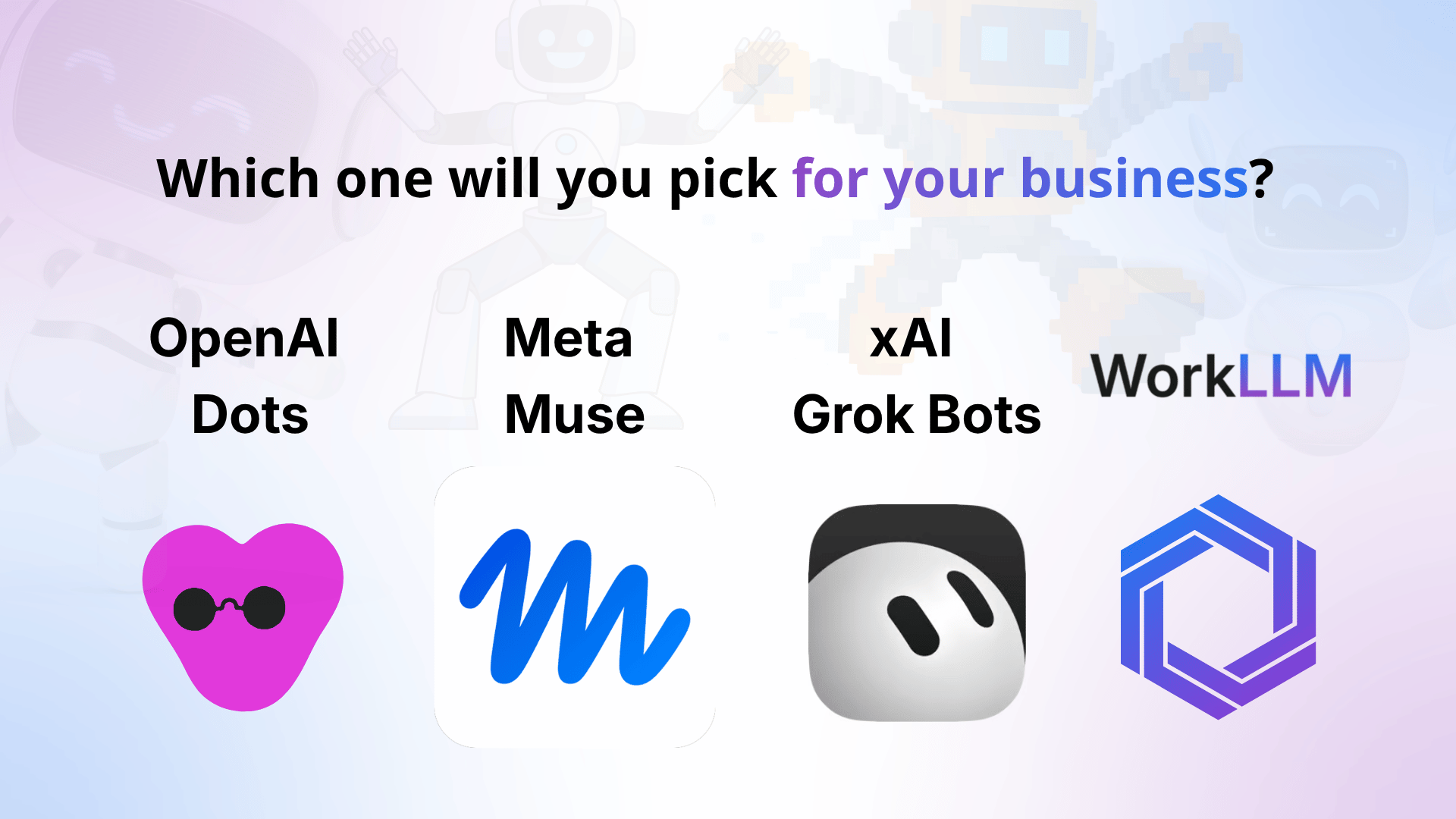
Picture a twelve-person agency. Every month, someone has to chase approvals, assemble invoices, and send each client a summary of what was delivered. Three of the largest AI companies now say they can take work like that off your hands, and each has a different idea of how. xAI opened Grok Bot in beta on August 11. Meta released Muse on September 8. OpenAI introduced Dots on September 29. All three are impressive products, and this article takes each one on its merits, then sets it beside WorkLLM, so you can see which approach fits the way your business works.
The short version: Grok Bot, Muse, and Dots are strong personal agents, and each does something very well. Each is tied to an individual account, so each person’s setup, memory, and habits stay with them. WorkLLM is organized around the workflow instead, which means an agent is built once, shared with the workspace, and tracked for usage and cost. The comparison below shows where that difference matters and where the other products are the stronger choice.
WorkLLM vs Grok Bot
What Grok Bot does well. Grok Bot runs on an always-on cloud computer with a browser, a terminal, and file access, and it keeps working after you close your laptop. Instead of writing instructions, you can show a bot a task once, and it drafts a reusable skill from what it saw. Routines then run those skills on a schedule. Because the bot works through a browser, it can operate any web app you can log into, and it can also use built-in connectors. Cursor’s plans extend it into real development environments.
How WorkLLM compares. Both products aim for low-effort setup and avoid code. The difference is what you see before the first run. xAI describes a learned skill as a draft, and you add the decision rules, failure handling, and approval boundaries yourself. WorkLLM builds an agent from a single prompt and shows the exact steps before anything runs. You can edit any step, pick a model for it, and choose whether the agent acts alone or waits for approval. WorkLLM also offers ready-made agents for sales, marketing, HR, and operations, so you can start from a working agent instead of teaching each task from scratch.
On teams and cost, the gap widens. Grok Bot has no standalone price. Access comes through SuperGrok and Cursor plans, from roughly $20 to $300 a month depending on the plan, with a usage allowance and overage billed on top. xAI’s documentation states that there is no Grok Bot-specific spend cap yet. Every bot on an account shares one cloud computer, which means shared browser sessions, files, and credentials. In WorkLLM, an agent built once is available to the whole workspace and always runs from its current version. Administrators see who ran each agent, how often, on which model, and at what cost, with role-based permissions, audit logs, and guardrails on every plan.
WorkLLM vs Meta Muse
What Muse does well. Muse is a polished personal agent that lives on a dedicated virtual machine in Meta’s cloud. It handles email, travel, bills, shopping, and the smart home, and it remembers details you mention only once. Its safety design is thoughtful: passwords sit in a credential store the agent cannot read, purchases use single-use card numbers, and it asks for your approval before sending an email or spending money. It is free to start in the US, with $20 and $100 monthly plans for heavier use, and it has since become available in Canada as well.
How WorkLLM compares. The two products are built for different jobs, and the comparison is mostly about that. Muse connects to personal categories such as email, calendar, payments, and shopping. WorkLLM agents act inside more than 100 natively connected business tools and reach others through MCP, so they can update a CRM record or send a Slack message as part of a workflow. Muse runs on one Meta model, while WorkLLM provides more than 200 models in one place, with up to four compared side by side.
Memory is the other major difference. Muse remembers one person’s preferences. WorkLLM’s organization memory carries your company’s documents, decisions, and brand voice into every agent, so any team member gets output grounded in how the company actually works. Muse has no shared workspace, single sign-on, or admin dashboard, and independent coverage has pointed out how much room Meta’s privacy policy leaves for the use of data shared with its AI. WorkLLM does not train on customer data, applies zero data retention at the model layer, and gives administrators usage analytics per user and per agent.
WorkLLM vs OpenAI Dots
What Dots do well. A dot is an always-on agent inside ChatGPT, running on GPT-6 Astra with its own cloud computer. It keeps working after you close the window, and you can reach it from ChatGPT, Slack, Teams, or by voice. It connects to more than 4,000 apps and can handle real engineering work, such as investigating a bug reported in Slack. By default it cannot send messages, edit files, or control your computer without permission, and you can write rules for what it may do alone. OpenAI is currently the most explicit of the three about shared work, with ChatGPT Space, a shared workspace where people and dots work together. The first dot is included with ChatGPT Pro and Business Premium.
How WorkLLM compares. Dots lead on breadth of app connections and on autonomous coding, and that is worth saying plainly. Both products offer approval controls, and both are moving toward shared work. The differences are in what is already in place for a business. In WorkLLM, a workflow is written as one prompt, and its steps are visible and editable before the agent runs. Dots learn your preferences over time, and a visible step plan is not shown before they act. WorkLLM’s organization memory brings company knowledge into every agent, while a company-wide knowledge layer for dots has not been confirmed.
Specialist dots for roles such as procurement, support, and contracting are in testing, and OpenAI has said the governance layer around them is being built with Microsoft’s Agent 365, a tool aimed at enterprise IT departments. WorkLLM already offers shared agents, per-run reports, and an admin dashboard, and it needs no enterprise IT setup. WorkLLM also stays model-neutral, while dots run only on OpenAI’s own model.
Side by side
| Capability | WorkLLM | Grok Bot | Meta Muse | OpenAI Dots |
| Designed around | The shared workflow | One person’s tasks | One person’s life | One person’s dot, team features emerging |
| How you create an agent | One prompt, steps shown and editable | Demonstrate a task, then refine the draft skill | Describe a personal goal | Create and name a dot |
| Ready-made agent library | Yes | No | No | Specialist dots in testing |
| Models | 200+, compared side by side | xAI models | Meta only | GPT-6 Astra only |
| Company knowledge | Organization memory | None | None | Not confirmed |
| Shared, always-current agents | Yes | Not documented | No | Space live, specialist dots in testing |
| Usage and spend per agent | Per user, per agent, per run | No Grok Bot spend cap | No | Not confirmed |
| App reach | 100+ natively connected tools plus MCP | Any web app, connectors | Personal categories | 4,000+ apps |
What changes when a team is involved
Return to the agency. Suppose two account managers each ask their own assistant to prepare client invoices. Each assistant has learned a slightly different habit, so the invoices differ in format and wording, and neither setup is visible to anyone else. When one of them takes a week off, her colleague does not inherit her assistant, and the task is rebuilt from scratch.
Nothing in that story is a defect in these products. Personal agents are meant to adapt to one person. A business needs one agreed way of doing the task, available to whoever is on shift, with a record of how often it runs and what it costs. That requirement is where WorkLLM is designed to step in.
What WorkLLM is
WorkLLM is an AI workspace that helps teams build, share, and run automated workflows. You describe a workflow in a single prompt, and WorkLLM builds an agent from it. For the invoice example, you would explain the process once, and the agent would ask about anything missing, such as which fields to include and who receives the result. From then on, everyone in the workspace uses that same agent, and a change you make shows up in the next run for everyone. On security, enterprise customers can use dedicated, physically isolated infrastructure, SAML-based SSO, and encryption at rest and in transit.
Which one to choose
Grok Bot is a good fit if you want to automate repetitive browser work that you can demonstrate once, and you already subscribe to one of the plans that include it. Muse suits someone managing personal errands who is comfortable approving purchases and lives inside Meta’s apps. Dots suit people already on ChatGPT Pro or Business Premium who want a background agent in Slack or Teams, and who are happy to adopt team features as OpenAI finishes them. WorkLLM is the better fit when the goal is for your whole team to run the same automated workflows, with visibility into usage and cost, your own company knowledge built in, and the freedom to use any model.
Frequently asked questions
- What is the main difference between these three and WorkLLM?
Grok Bot, Muse, and Dots are built around one person’s account and one person’s habits. WorkLLM is built around the workflow, so an agent is created once, shared with the whole workspace, and tracked for usage and cost. - Can a small team use Grok Bot, Muse, or Dots together?
Dots come closest, with ChatGPT Space for shared work. Grok Bot has shared Team Bots in beta, though bots on one account still share a single cloud computer. Muse is a single-user personal agent with no team features. - Which one is best for coding and technical tasks?
Dots and Grok Bot are the stronger choices here. Dots can investigate a bug reported in Slack, and Grok Bot reaches real development environments through Cursor. WorkLLM’s coding help works inside the chat and does not act directly in your codebase. - How do the costs compare?
Pricing for all three is per person. Grok Bot comes through SuperGrok and Cursor plans from roughly $20 to $300 a month, Dots include a first dot with ChatGPT Pro and Business Premium, and Muse is free to start with $20 and $100 plans. Per-person costs multiply as you add team members, so compare against your own headcount. WorkLLM’s plans are listed at workllm.io/pricing. - What happens when the person who set up an agent leaves or goes on leave?
With a personal agent, the setup stays with that person’s account. In WorkLLM, agents belong to the workspace, so a colleague can run the same agent from its current version without rebuilding anything. - Do I need technical skills to set up WorkLLM?
No. You describe the workflow in a single prompt, review the steps the agent will take, and adjust anything you want before it runs. - Can I use WorkLLM alongside one of these tools?
Yes. A personal agent can keep handling one person’s individual tasks while WorkLLM runs the workflows your team shares. The tools do not connect to each other, so each keeps its own setup and memory.
Where to go from here
These three launches show how quickly AI is moving from answering questions to completing tasks, and each one is worth taking seriously. For a business, the more useful question is whether the work ends up running the same way for everyone on the team, with a clear record of what happened. To see how that looks for your own workflows, explore the AI agents at workllm.io or write to hello@workllm.io.
Author Details

Product-focused founder with deep experience in AI, enterprise software, and data platforms. Passionate about turning complex workplace problems into simple, scalable products.